Wednesday, 23 July 2014

Running backstays

The inner forestay, when tensioned, will bend the mast and sag, unless the mast is supported from the opposite side. This is usually achieved with running backstays (runners) - a pair of wires attaching to the mast near the inner (or, on fractional rigs, only) forestay and tensioned alternately, with the windward one taking the load while the leeward one is eased. The running backstays are needed to fly the staysail on the inner stay, just like the main backstay must be tensioned to fly the jib on the main forestay.
Running backstay (right) supporting the mast

Monday, 14 July 2014

Haul-out weekend

The first weekend of July had been reserved for out-of-the-water maintenance. Auriga was lifted on Friday evening, and we had until Sunday evening to complete all the inspection, repairs and painting.
Our main goal was to clean the hull and renew the antifouling - a layer of special paint previnting growth of any wildlife on our hull.

Tuesday, 8 July 2014

A video tour of Auriga

Over the weekend, Richard took his junk-rigged Tammy Norie up the Orwell to Fox's marina. We had a chance to have a look around each other's yachts and exchange tips on equipment and maintenance. While Auriga was out of the water, Richard filmed a quick tour of the boat. Enjoy!

Sunday, 29 June 2014

Storm Staysail - Ready to Hoist!

The staysail, kindly donated by Richard F., is ready for it's next big adventure. Initially equipped with a luff tape and a head strop to be hoisted on a boat's main forestay, it had to be adapted to Auriga. As explained before, we decided to have hanked-on headsails throughout. Further, the luff extended with the strop was too long for our inner forestay. Thus, we had to shorten it while keeping the full-strength eye for attaching the halyard, and insert stainless grommets and hanks along the length of the luff. While Matt was preparing for his viva, I made best use of Richard B.'s living room to work on the staysail, as well as to finish stitching on the remaining jibs.

Wednesday, 25 June 2014

New Electrics - 12V

Getting the boat back to England required mostly quick fixed to the existing system. Surprisingly, most electrics worked, and we learnt what a "torpedo fuse" is (found in old Italian cars and in older boats by young Italians). Some fuses would fall out every time the boat slammed into a wave trough, but it got us here. For more extended passages, it seemed appropriate to make sure the system is simple, reliable and maintainable. We installed LED lighting, replaced a lot of the wiring throughout the boat, and re-run all of it to the new heart of the electrical system - the switch panel above the chart table.
Old fuse panel (bottom)
New circuit breaker panel with 12V sockets and more

Wind of Charge

Our yacht's navigation lights, instruments and other appliances draw power from the battery bank comprising two 110Ah batteries. This means we could (in theory) run, say, a light with a power of 12W - corresponding to a current of 1A - for 220h, or 9 days. On longer passages, this obviously means that we must have ways to charge the batteries - and/or keep our electricity consumption to a minimum. On the latter front, we have replaced internal lights, as well as the tricolour - a masthead navigation light used while sailing - with efficient LEDs. For charging, Auriga came equipped with the engine alternator and a dated wind generator (Rutland 913) - a favoured option for offshore sailing providing almost unlimited clean energy. Unfortunately, the old wind generator suffered irreparable damage following two ocean crossings and 12 years in the scorching Spanish heat - the bearing which allowed it to turn following the wind direction seized. A replacement was needed.
Our new wind generator 

Thursday, 12 June 2014

Current Affairs

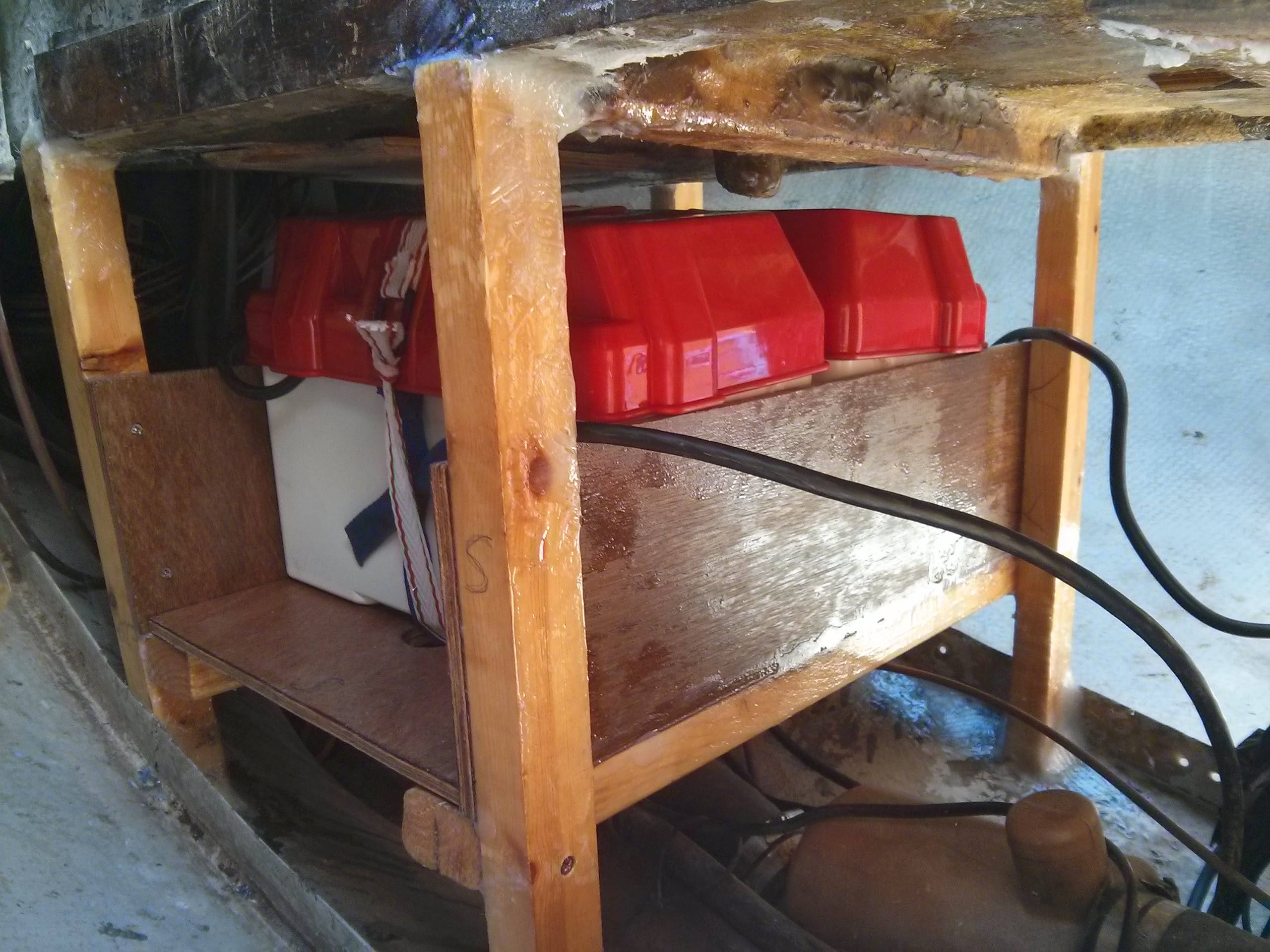
Another item on or wish list has been relocating the batteries and simplifying the cable routing. Previously, one battery was stored under the cockpit floor, while another battery (and the battery switch!) were in the starboard cockpit locker. Opening a locker lid at sea just to switch batteries seems less than ideal, and the inaccessible space under the cockpit looked ideal for the two batteries.